Monday, July 15, 2013

Sean Parker tells us that Central California Steelhead trout are not endangered

Redwood creek in the Muir Woods, CA.  Redwood creek has native Steelhead trout.  

A recent post over at the Trout Underground talks about some pretty uninformed garage that came out of Sean Parker's mouth while defending his super extravagant wedding.  I really have no intrest in reading anything Sean Parker has to say but since it was on a site I read religiously I happend upon it.  The gist of the wedding fiasco was that a hotel in California is in close proximity to a redwood forest and a creek that has supported spawning of the endangered California steelhead trout. In order for the wedding to take place Parker paid $2.5 million in fines to California Game and Fish.  I've been trying to wrap my head around why there would just be a fine instead of just not letting the event take place but I guess the money fined would be enough to cover any dammage the Game a Fish department foresaw happening.  The way I see it is he just parked in a handicap spot; you aren't supposed to do that incase someone needs that close spot but if you do you will get fined.  Parker basically is that jackass that pulls in right up front in the handicap spot and can afford the fine and he thinks he is entitled to the spot.

The other part of the Underground post talks about how Sean Parker figured this whole endangered species problem out with a simple google search.  Apparently, lots of media type people were pretty harsh in how they depicted Parker's wedding so he responded.  Here's the quote from Parker:


"Then there was this question of a certain fish, the “steelhead trout,” that was purportedly threatened by our wedding preparation. The media reported that this fish was an “endangered” species whose spawning ground was a creek near our wedding site. Yet a simple Google query of “steelhead trout” reveals that this fish is not, as the media had reported, a truly “endangered” species, but rather a fancy variant of the common “rainbow trout” that is abundant across North America — so abundant, in fact, that it is sometimes considered a pest species. (The steelhead, like salmon, travels upstream and spends its life in the ocean. This variant of the rainbow trout has seen its populations fall in some areas of California where it is protected, but it’s hardly the endangered species the press made it out to be. In fact, the National Wildlife Federation reports that rainbow trout is “not at risk of extinction.”

I don't even know where to start.... A "fancy" varient of rainbow trout?  This guy is supposed to be smart or something right?   The problem is these fish are not endangered everywhere so it is hard for people to understand that the specific fish that has the specific genes that allowed it to adapt to the drier and warmer than average California spawning areas Is endangered.   You can't just put back stocker "rainbow trout" in post creek and expect successfully spawning steelhead runs in ten years.  Once the fish are gone from Post creek and other creeks like it in California they will be gone forever.  The genetic makeup that allows for their success in that environment will be gone.  Look at the variation in humans; we are all Homo sapiens but sherpas sure are better suited than I am to climb Mt. Everest.    He googled it though so, you know, he has to be right.  Search for more than what you want to find and maybe you can come close to understanding the issue.  In case you are as upset about this as I am here are all the ways I can find to not support Sean Parker.

He is a partner in the venture firm Founders Fund.  Here are the companies that they support:

 If you want to learn more about Steelhead trout and their conservation check out CalTrout.org. 

Monday, August 27, 2012

Upper Colorado and the Fraser River


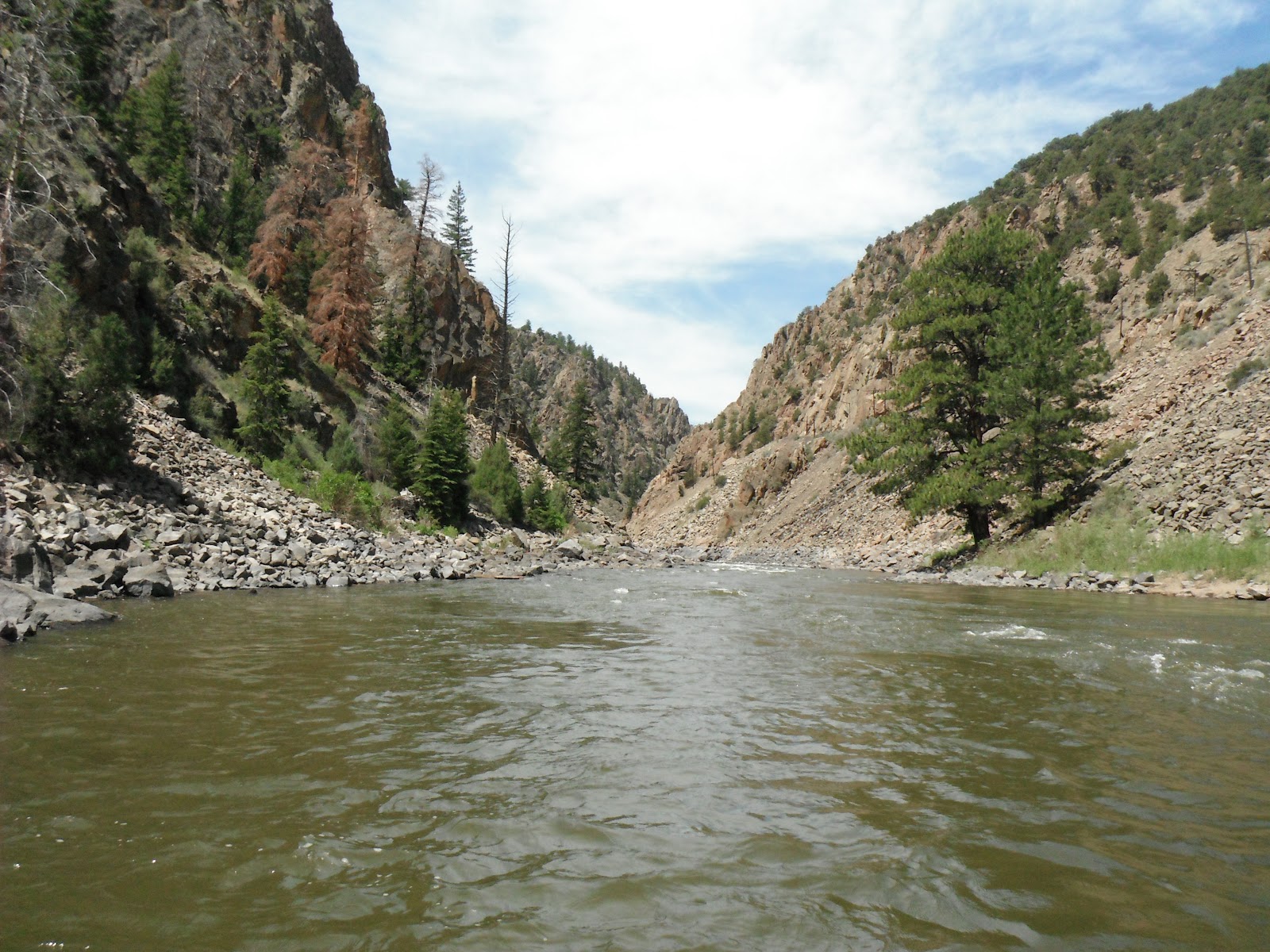
Gore canyon


 I set out this weekend to catch some bigger fish.  I have spent most of the summer exploring small creeks for native fish and fishing the Poudre.  I decided to fish Gore canyon up stream from the Pumphouse put in the Upper Colorado.  I went on a float trip up there in June and caught some really nice browns that mostly went about 13-15 inches.  I got camp set up by 1 and fished until dark.    I tried just about everything I could think of, most two nymph rigs with various larger heavy flies trailing other smaller nymphs.  I didn't have much success.  I caught two smaller browns but nothing of size.  Just before dark at my campsite there were a few risers and I picked up my largest fish of the day (all of 11 inches) on a para Adams.  I did hook a decent sized fish right at the launch by he got off after a few good thrashes.  Almost counts.

I'm sure with more experience in the area I would do better or at a different time of year maybe.  It's still a beautiful place with lots of places to explore.  Gore canyon did have quite a bit of pressure, which I was not expecting way out there.  I saw at least 7 other fisherman along about a mile of river.  Way to crowded for my taste.  However, that probably means there are some big fish to be had if they are eating. 
My camp site right next to the upper colorado. Beautiful.  


Amtrak passengers with a great view of the river.


My next stop was the Fraser river near Tabernash.  I had heard there were big fish to be had around there so I guessed on a spot and ended up getting lucky.  Unfortunately, the Fraser is a slimed cesspool of didymo and algae.     Every rock, branch or log in the river was covered in slime an inch think.  Nearly every cast I had to clean off my flies.  The filth sluffs off in the current and keeps the visibility at about 3 feet.  On top of all that, no cutthroat either.  I caught one big rainbow and one decent brown but will not be going back.  Maybe someday I'll find a beautiful clean mountain stream that has big native fish but for now, that seems impossible, in CO at least.  The rainbow was pretty big though.  I'll have to do some measuring in the photo but the fly I caught her on was a #20 so I might be pretty close to the famed 20/20 club.  
Fraser river.
Looked at a bunch of rocks and there were case building caddis everywhere.  I bet that hatch in May or June is epic.  


Nice brown.  Nice close up of the slime that covers everything too.  

My big Rainbow.  Doesn't look very big in the picture unfortunately.  Sort of curled up in the net.  She was too big for me to get my hand around to lift up. So, yeah, pretty big.

Lots of pictures from a float trip with my buddy down the Colorado.  We floated Pumphouse to Radium.  


Wednesday, August 22, 2012

How to tie an Elk Hair Caddis

Sometime switching to a #12 PBR is all that works.....


I recently started to tie flys again and now remember why I stick to nymphs and streamers.  Wrapping hackle is hard, it costs too much and I just can't manage to not crowd the eye on a #18 Parachute Adams.  There is nothing worse than having the right fly that you know would work but you can't tie it on because the eye is totally covered with material.  I found a piece I wrote a while back about tying Elk Hair caddis flies.  There are a few stages in fly tying.  Everyone starts out as a beginner and rarely does anyone become an expert.  I'm pretty much a intermediate tyer which means I can tie serviceable nymphs  buggers and Clousers.  Thats about it.  Here are two versions of how one should go about tying an EHC, one for the beginner and one for the intermediate tyer.


Amateur:
Start with a size 8 2x long heavy gauge nymph hook.  (only hook left in Cabelas fly tying kit)

Wrap half a spoon of tread to coat the hook shank. 

Tie in a purpule marabou tail. (strictly out of habit because all you tie are wooly buggers and purple is the only color that came with the cabelas kit)

Cut off marabou

Tie in copper wire (no extra fine silver)

Tie in brown rooster saddle hackle at the base of the feather that is about 2mm thick.  (Again, the only feathers you have are for wolly buggers and you already tried partrige and that looked dumb)

Wrap saddle hackle forward and tie off. Cut excess and watch it unravel. Rewrap and tie off too far back.

Trim saddle hackle to the right length since the barbules are big enough for a 2/0 pike fly. 

Add 2.7 oz head cement to secure and matte down what you are loosely referring to as hackle

Cut off 3x too much deer hair (whats the difference Elk, Deer? same thing)

Don’t stack the hair.  I know, “what do you mean STACK the hair?” Don’t worry about it you don’t have a stacker anyway.

Don’t trim it just tie it in too close to the eye

Loop twice around like you read and pull down with slight pressure. SNAP

Screw it.


Intermediate:


Start with a size 12 dry fly hook.  This is the only size you have and its two sizes too big for the water you fish. 

Don’t use gel spun thread.  I know, “what’s gel spun thread?” You don’t have any. 

Wrap on pearl flash

Tie in wire at bend

Tie in dun cabelas brand bargain dry fly feather back from the eye.  At least it’s the right size…..

Wrap hackle back and secure by wrapping wire forward towards the eye.  Secure wire

Cut elk hair and stack.

Measure and cut to proper length. 

Make two loose wraps around hair pull to secure

SNAP!

You can try this a few times but go ahead and get some GSP.  

Thursday, June 7, 2012

Fly fishing for native brown trout in Belgium


After I decided I wanted to see where brown trout come from and catch one in their native range I ran into a stone wall of information blockage on the internet.  There really is very little information about where to fish, the rules in each country and the rules regarding private and public land.  I first looked in Germany for places to fish.  A number of sources say there is no public water in Germany.  Each fishing spot requires a separate permit from a land owner and , of course, none were available online.  Plus, there apparently is no catch and release.  I have no idea how accurate any of this info is but that was what pushed me to a new area.  There was no way I was going to bring back trout to a hotel room or whatever I would have to do with the fish I caught.   France was a little too far away but Belgium was pretty close to Amsterdam, where I was traveling to first for a conference.    If you search for fly fishing in belgium you pretty much get one site.  http://www.flyfishingbelgium.com/  Sebastien is the guide I worked with and he is an excellent fisherman.  He also specializes in river restoration and after seeing the size of the fish in the streams he guides I bet he is really good at that.  I fished the upper Bocq and La Molignée river.  The water was a little off color due to some rain so it was hard to tell how many fish were in the river.  If I had to guess I would say there were fewer trout than I am used to in both Minnesota and Colorado but they are much bigger on average.  The average fish was a husky 15 inches and there were very few smaller that I caught.  I managed to hook, fight and break off the biggest trout I have ever seen on this trip. 


 I got into position about 15 feet behind a rising trout.  The cast was awkward, like they all were on the upper Bocq.  I was fishing a emerger pattern on 5x that Sebastien ties.  It is very sparse and all black.  I managed a few casts, two of which were right over where the fish was rising, with no response.  Sebastien calls out, form the other side of the stream, I think he is eating caddis, do you have a dark caddis to tie on?  I did and I switched flies.  While I was tying on I got a better look at the fish during a rise.  It wasn't a whole body flip but just a sip of the surface film.  I saw what looked like an alligator head poke out of the water only an inch.  The head was as big as my fly box which made me wonder what this fish was interested in my #18 Elk hair caddis for.  Later I would regret not changing to a heavier tippet.  I laid out a cast right over the beast and again, just a sip.  I set the hook and it felt like I snagged a log.  Nothing.  barley a wiggle.  He settled down to the middle of the pool like a log.  Then, with a flick of the tail he was alive and all over.  He headed towards the bank Sebastien was standing on and I yelled NET, NET!!!! Sebastien said it was too early but he didn't realize how big the fish was.  Then he came up and flashed us broad side; he looked like the size of a king salmon.  Thick and at least 30 inches long.  He took line like a tarpon and headed up stream.  I got some back and it was going well.  Then, he headed for the overhanging roots of a big tree, Sebastien shouts Watch the roots!, a slight twinge of my line hand, unconsciously.  Snap.  I checked back and never saw a rise in that spot again.  I tried everything later and the next day in that spot.  Nothing.  Just another fish story to you but I know what happened and even though I didn't land him, it was awesome.  
There was an intermittent hatch of giant yellow may flies.  I just missed the  madness that hatch is supposed to bring.  
I'm not going to tell you its easy to find a place to fish in europe but it can be done.  My advise?  Get a guide, get a gps (I didn't have one), make reservations way ahead of time and book through Sebastien.  He was great and knows how to fish the area. I would have been skunked without him.   You will have to rent a car wherever you go and the freeways are very well marked and easy to get around on, the roads in town however are not really marked and you will get lost.  Other places I looked into but were too far away for me were Slovenia and the Black Forrest in Germany.  If you are going on a strictly fishing trip go to Slovenia.  If you are just on European vacation and want to fish for a few days book through Sebastien. Its great to get out of the cites and see the country side in Europe.  The south of Belgium is beautiful and there are hundreds of small towns to explore, great biking and lots of great restaurants to check out.  It really reminds me a lot of the bluff country in South eastern Minnesota except with Roman ruins, castles and better beer.   
Fish tended to rise in what Sebastien called special places.  See that tree on the left and that huge ball of roots? A fish was rising right in front of it.  As you can see below, I got him.  I used a down stream presentation with one of those monster yellow may fly patterns and he took it just after it sunk beneath the surface.  


Average size native brown on the upper  Bocq


There were 3 fish rising in this run.  My favorite part of the whole trip was working my way up and catching all three each larger than the last.  


The Bocq as it passes through the town of Spontin


Dinant just south of where I was staying in Ahnee.  


Wednesday, June 6, 2012

Native Trout


A native brook trout stream in Minnesota.  This tiny spring creek was likely only spared brown trout infestation because of its size.  Somehow, fish have hung on here for hundreds of years.  


I have spent a lot of my time fishing for brown trout.  I started fly fishing in Minnesota where most streams or creeks that would historically have brook trout are now brown trout fisheries.  Only once in 6 years did I ever catch a brook trout in a stream where brown trout were abundant.  There are remnant populations of native brook trout and also newly resorted streams with stocked but wild brook trout but most of the trout or cold water habitat in Minnesota and the rest of the drift less region has been overrun with brown trout.  Mostly due to the water quality and slightly warmer than historical temperatures brook trout are no longer suited to survive in the drift less area streams and creeks.  At least, that's what the DNR and TU says.  My feeling is there is a lot of habitat that is good enough for brook trout but brown trout are a more desirable sport fish.  Since brook trout and brown trout both spawn in the fall there is a greater likelihood of interspecies competition for spawning beds.  A similar situation exists out west where the introduction of rainbow trout to cutthroat habitat has lead to a reduction in cutthroat numbers.  Each of these unnaturally cohabitating species can interbreed creating tiger trout in the case of a brook trout/brown trout cross and a cutbow in the case of a rainbow/cutthroat cross.   However, the tiger trout is sterile and the cutbow is fertile which makes introduction of rainbow trout to cutthroat habitat more damaging due to  genetic pollution of the native cutthroat population.  
A Native Minnesota brook trout

Heavily camouflaged brook trout.  Even the orange belly is hidden behind black pigment.  

All over the country in all types of water there are non-native species decimating native fish populations and it's all our fault.  We move fish from waterway to water way for many reasons.  Sometimes it is a handful of ignorant people who do the damage, like whomever put lake trout in Lake Yellowstone, and sometimes its the government  who imported brown trout from europe in the 1800's which lead to the decimation of countless brook trout populations nation wide.   My problem is that no one even knows what their local stream was like before we messed it up.  I live in Fort Collins, Colorado now and mostly fish the Cache de la Poudre river.  At one point, there were nothing but green back cutthroat trout in the Poudre as well as all other eastern slope streams like the Big Thompson, the South Platte and even the Arkansas.  Green back now occupy less than one percent of their native range.   Their once immaculate habitat invaded by rainbow and brown trout, damed and diverted into vestige of what it once was.   I often wonder what it must have been like before the front range grew to the point that mother nature needed some rearrangement to accommodate all the inhabitants.  I also realize I am part of the problem.  I moved here from Minnesota for many of the same reasons people from all over the country find the front range so appealing.  Ironically, it's the outdoor recreation opportunities that make Colorado so great.  For all the damage rainbow and brown trout have done to native fish I still enjoy catching them.  I felt like I needed a little more appreciation for brown trout.  Even though I scorn them for not even being native to this continent I feel like they have a place here now.  They entertain millions of anglers and are likely better suited to some of our warming and changing river ecosystems.  I decided I needed to see brown trout in their native habitat to better appreciate the species that has given me so much enjoyment and caused so much harm to our environment.   I recently got back from fishing the Bocq river in the south of Belgium where I was surprised to find the habitat was eerily similar to where brown trout thrive in Minnesota.