Thursday, April 21, 2011

Baghdad Fly Fishing Club

Check out this Slab of the month entry on Moldy Chum. Steve Peterson serving over in Iraq sent in picture of a pretty nice slab.  He is a member of the Baghdad Fly Fishing Club and they could use some gear to help outfit their club members.  You can send donations by mailing them to one of these two addresses:
BACSFF C/O
MAJ Dave Cloft
USF-I J5 Assessments
Unit 42001
APO AE 09342

If the above address fails, send to:
BAC&SFF C/O Joel Stewart
3461 Calavo Drive
Spring Valley, CA   91978 
 This is a great chance to find a home for your unused fishing gear.  You can see a list of gear they are in need of here.  I hope everyone can send out just a few things they have lying around.  It all adds up and will provide gear for our troops overs seas to try and find some relaxing time between what must be a stressful situation to say the least.  

Wednesday, April 20, 2011

Rush River BWO's and the crowd

The Rush is a classic driftless region lime stone bluff stream

To say the Rush river is a popular fly fishing spot is an understatement.  I have avoided it until now for two reasons.  One is Access.  This is a common problem for streams in Wisconsin.  Maybe I haven't come across the right info, but I can't find a map that has a clear indication of what land is private with an easement, private with no access or public.  Minnesota publishes an invaluable book that marks each trout stream, shows the regulations and where easements have been secured.  My approach in Wisconsin: find a river, drive to a spot, and check for no trespassing signs.  A driftless anglers best bet in this situation is to consult the driftless bible, Trout Streams of Minnesota and Wisconsin by Jim Humphrey and Bill Shogren.  This book has all you need to start exploring the streams of Wisconsin including maps and a little info about each river.  There is not so much detail that you will know a specific spot to fish, but the book will get you to a general spot that can be explored.   After all, exploring a new stream is half the fun.  I owe a lot of my fishing success to those two guys, and I am so thankful they produced such a great book. 
    The other reason I haven't fished the Rush until recently is it's so crowded.  Well, it is and it isn't.  It's a big river.  I drove up A from the Mississippi past about 4 spots detailed in the book and one other I had heard about.  2 spots had one car.  One had none and the other had at least 7.  Since I haven't fished that spot I have no idea why so many people were out there but geez.  If I see two cars I move on to somewhere else.  I look for no cars or one if it is a crowded weekend.  There are plenty of fish and spots on the river.  I wouldn't want to fish with 10 other people on a section of river anyway.  I moved on to another spot, saw one car parked and saw the guy walking down stream.  I parked and headed up.  I saw one guy coming back down and I worked past him up stream.  I didn't see another person until I got back to the 3 pools closest to the access point.  All three were occupied.  The funny thing is I only caught one fish out of those three pools on my way out.  Up stream a half mile or so I got 8, almost all on #20 or #18 (after I destroyed my #20s form catching so many fish I switched to 18s) BWOs.  The pressure is super high at the bridge crossings and the first few pools but if you get out to the 7th or 8th pool, chances are you will be the only one out there and the fishing will be better.  I do the same thing at the lower Kinny when there are lots of people.  I walk out until I pass two runs or pools with no one in them then I work my way back.  Usually, by the time I get back to the popular pools they are empty.  Moral of the story is get out and walk until it's not crowded anymore.  You will catch more fish, get better exercise and not waste your time on a bunch of spooked fish. 
Wide, and not shaded.  The Rush has some challenging runs

Only fish I got on a nymph.  #18 BH flashback pheasant tail.  Smaller than average fish for the Rush


Below is a video of the BWO hatch last Sunday.  Pretty consistent like that for hours.
    Another early season thing to consider is shade.  The Rush is wide in spots and the trees this time of year are not shading any part of the stream most of the day.  Generally, fish stay out of bright runs or feeding lanes when there is no shade.  If they are out there it won't take much to send them to the bank for safety.  The good thing is fish are hungry this time of year, so there may be feeding fish out in a sunny spot anyway.  Look for spots with a little shade though;  I think the fishing will be a bit better there.  Later in the day when the shadows get longer may be the best bet this time of year. 
    Cloudy days this time of year are a great thing.  This Saturday looks like it might be a great day for a BWO hatch.  I got a nice 14-15 incher on the Rush last Sunday on a #20 BWO.  Still working on my 20-20 club though.  (20 inch fish on a size 20 fly)
Nice 14 incher on a #20 BWO.  Glad I had my net.  This guy hit the fly and just sat there in the current for a few seconds with me pulling on him.  Then he decided he'd had enough and headed for the deep bank side. 


My last #20 BWO.  Mangle.  Got a few more on #18s


Monday, April 4, 2011

What can you do?

Sneaking up on trout during a hike.  Hope days like this are just around the corner. 
I'm ready for some bigger fish like this. 


I didn't go fishing this weekend.  Actually, I didn't even think about going.  I took one look at the Mississippi and thought  the trout streams would look about the same.  High, fast and chocolate brown.

Maybe I should have gone.  Catching trout under those conditions is tough but not impossible.  I walked the Kinnie a few years back around the same time of year.  I had never seen the river so high and off color.  I brought my rod down but I wasn't serious about fishing.  I stripped a wolly bugger across a few runs but got nothing.  I ran into a guy who said he got 4.  I couldn't believe it.  Then I saw him get one along the bank.  He was high sticking nymphs along the banks.  With the high water, the banks turned into the perfect spot for trout to get out of the current.  The banks were higher, since the water was up, and had more room for the fish to stack up.  I guess you learn something every time you go out.  It makes a lot of sense though but it's just hard to do the opposite of what you normally do on a stream.  Typically, I would be standing about a foot or two off the banks and cast to the deeper part of the pool or run and that would be where a majority of the fish are.  Now, I was standing where a majority of the fish were.  The center of the stream was a torrent of rushing water.  The fish were not out there, that would take way too much energy to maintain.  I'm going next weekend, high water or not.  Here is what I'm thinking for tactics, any of your ideas would be appreciated.  I haven't fished these conditions often so I could use some help.

I'm going to forget about dries until the water comes down. I am not, however, going to forget about emergers.  I think a lot of hatching insects just get tossed around in water like this.  I'm not going to go for the just below the surface film emerger type fishing.  I'm going to fish a two nymph rig with a small bead head (maybe with an extra split shot if the water is really moving) and a soft hackle emerger about 16 inches off the bend of my nymph.  If insects are hatching off the bottom I really don't think they could get up too high without getting swept down stream.  Plus, I doubt many fish will be darting out into that current very often.  We'll see how it goes.

Monday, March 7, 2011

Wisconsin Catch and Release Season Opener


I fished the lower section of the Kinny in Wisconsin early season last year and it was kind of a zoo.  I guess it is a good thing that there are lots of fly fisherman out there.  It was hard to find an open spot, but I eventually found my favorite spot just being vacated by another angler.  I ended up with 4 or so on the day thanks to that spot.  I only got one fishing new and slightly less desirable spots earlier in the day. 
This year I decided to fish a smaller, less well known brook trout stream instead of the more popular lower Kinny.  I got out at noon and fished until 3 or so.  It was pretty warm but just cold enough to get a little ice in the guides.  It also got windy.  On this stream, I never fish heavier than a 3wt. The biggest brook trout I ever landed out of this stream was about 12 inches so a 3 wt makes the smaller fish more fun.  I really had a hard time casting in the wind.  I was fishing a tandem rig with a #16 parachute Adams and an orange scud about 18 inches off the bend of the Adams.  Fighting the wind usually means making tighter loops that are more resistant to the effects of the wind but a tandem rig is best fished with open loops.  Both cases were a mess.  The stream is about 5 feet wide and down to as little as 3 feet wide and I felt like I was hitting the water about 60% of the time.  Without wind I can typically place 3 drifts in this stream, my side of the current, in the current and the other side of the current.  Yesterday, I was lucky to get my fly in the water.   The stream meanders around an open field so each pool was either a head wind, cross wind or any other variation.  The casts I did put in the water were catching fish though.  I got maybe 3 off my Adams and 6 or so on the scud.  I also tried smaller pheasant tails and midges as a trailer fly but go no hits on them at all.  I had one on that may have gone 12 inches but I lost it after a few head shakes.  I was fishing barbless and they were tossing my scud fairly often.  I looked back at my pictures from last year and the orange scud was the ticket back then too.  Orange scuds are supposed to represent dead scuds that are drifting down stream.  Scuds that are alive are either gray or olive or, I guess, a bunch of other colors but not bright orange.  Maybe the winter kills a lot of scuds and the trout see those more this time of year.  Who knows, but that fly has been working pretty well for me this year.

I did see a few rises and I saw some blue winged olives that were about #18 or smaller.  This is the earliest I have ever seen those guys.  Baetis were a welcome site after a early winter season of no dry fly action.


I have released about a hundred fish and have tried to get this shot every time.  Finally got a good one!


Friday, March 4, 2011

Best fly rod for the Driftless region


Someone searched the above title and my blog popped up.  I haven't really addressed this question and I love talking about fly rods so I thought I would give it a shot.

First off, fly rod choices are very personal.  Some people only fish bamboo others swear by fiber glass.  Graphite is the most popular choice today and is what most fly rods are made of.


The first important decision is fly rod weight, but that isn't the first question you should think about.  First off, how many rods are you going to buy?  One? Choice is made for you, get a five weight.  Two? For the driftless region I would get a 3wt and a five weight. Three? My first two were a 5 and a 3.  My third was a 6'6'' 3 wt fiberglass slow action rod I built for small stream dry fly fishing.  I love small streams and native fish so I went the small route.  A short about 7' 1wt or a 0wt would have also been a nice choice. I picked a short 3 because I already had a reel and line for it.  That saved me a hundred on line and a reel.  If you love catching big fish and do some warm water fishing (bass and pike etc.) I would get a 7 wt.  Great for steamers for trout and could toss a bass bug without a problem.  Think about an extra spool for the 7wt reel; you may want a shooting head for steelhead someday.  I picked odd numbers because my first rod was a 5.  A 4wt and 6 wt would also do well but for long term species flexibility I like the 3-5-7 range.  I use an 8' 3 wt nearly every time I go out fishing in the driftless region.  It's a Winston Ascent which is supposed to be fast action, but since it's a Winston it's a little softer and fishes nymphs and dries pretty well.

That brings me to the second most important choice.  Action.  Fast? Super fast? Slow? Medium? It's mostly a personal preference but certain actions fish different types of flies better.  A very fast action rod will generate very tight loops and demands a very well timed casting stroke (think Scott S4).  It's best for people who can cast better than me and fish dry flies more often than I do.  Medium fast action rods can still form a tight loop when fishing a single dry but can be cast a little slower to make bigger loops that are best for two fly rigs and indicator-nymph rigs.  Medium and slow action are for very relaxed casting strokes and delicate lay downs.  Think very slow sections of spring creeks with gin-clear water.  The Driftless region has more than its fair share of water like this, so a slower action rod would be nice sometimes.  Unless its windy.  Forget about casting a slow action rod in the wind.  Cutting wind takes tighter loops and a more powerful stroke which is not a slow/med action rod's forte. 

Next is length.  Is 9 feet too long for the spring creeks of the Driftless region?  Not really.  9 feet is a good fly rod length.  It may get tight is some spots but I like a 9' 5 wt over an 8' and I think it mends better than a 8'6".  For a 3 wt I like an 8 footer. It gets you into a light weight rod that is more fun with smaller fish and a little shorter for the tight brush and trees.  My go to rod (unless there is wind) is an 8' 3 wt.   4 wt? not sure, maybe split the difference at 8.5 feet. 

Now the tough one: cost.  Basically which brand is for you.  Fly rods fall into 3 main price categories: around $200, about $300-500 and above $600.  I have no data for this but considering the choices available in the $200 range I would say most people are buying in that range.  In the $200 range I love the Winston Passport.  The 5wt was ranked higher in a head to head test over a lot of really expensive rods. TFO makes some really nice rods in that range.  Echo also has some great $200 or under rods. I also like the St. Croix Imperial, which is a great rod for the money.  For the $300-500 range I wouldn't know.  I don't own a rod that nice. If I had to pick... I would go with the Winston GVX.  It has the same taper as the Winston Boron rods but is made with only graphite.  It is made in Twin Bridges, Montana with the same exacting standards and finish as the rods that are almost $300 more.  Other interesting rods in that category are the Sage VXP based on the super popular XP from a few years back ($500) and the Sage Flight $300. The Echo 3 also looks pretty sweet at $300.  Red truck is a new company that makes a pretty high finish and sweet rod for $300.  The Diesel has a aluminum tube with a bottle opener on it.  As far as I know, its the cheapest rod to offer an aluminum tube. The Orvis Hydros is also quite a lot of rod for the money at $500. It is made with the same technology as the Orvis Helios but without the $775 price tag.  Over 600?  Take your pick.  I can't imagine one of those rods being bad.  Just make sure you get the appropriate action for your casting stroke and fishing techniques. Many of those high priced rods are built as super fast action rocket ships for huge casts.  Not really necessary in the Driftless region.  You need a good all around rod since hatches can be more sporadic and less consistent out here compared to the west.

  If you are just starting out and think $200 for a rod is out of control, there are a few options that will get the job done.  Don't buy a kit rod that has everything in one box.  The line will be crap and it will cast limp noodle.  A rod will cost at least a $100.  Try the St. Croix Rio Santo, the Reddington Pursuit or the TFO series 1.  Find the cheapest reel you can, don't be above a Pflueger medalist ($23) and get a decent line (~$50).  So, for less than $175 you can get a serviceable outfit that will get you years of enjoyment.  If you are new to casting a fly rod and are getting a 5 wt only think about trying a line size up, so a 6 wt line for the 5 wt rod.  It will let you feel the rod loading a little more and make your timing better to start with.

I hope all this helps. I love writing about rods.  Maybe someday I'll try reels.

Tuesday, February 15, 2011

First trout of 2011


I know, this fish makes the #18 midge look big.  He still counts though.
I got back out to Hay creek on Saturday.  It was super nice out and above zero so no frozen guides. I thought the fishing would be pretty good but it was still really tough.  Maybe I am just fishing a tough spot.  The only thing I got a bite on was size 18 midge nymph.  There was actually a little hatch when I first got there and I saw two rises in the first pool I fished.  After that, I didn't see anything break the surface.  I was fishing deep, which is usually the best tactic in the winter but maybe they were feeding on midge emergers.  I didn't see any fish up high just hugging the bottom so I figured not.  I just got one little 9 incher.....  It was nice out and I didn't get skunked so I guess it was a good day.  A frustrating day but a good day. 


The light on the river as I was leaving was great.  Looks like this one needs to be straightened.  I was scared of falling in. 

These were the guys walking around on the snow.  I saw these and adult midges with the fluffy white antenna. 
My guess is stone fly. Anybody have a better guess?
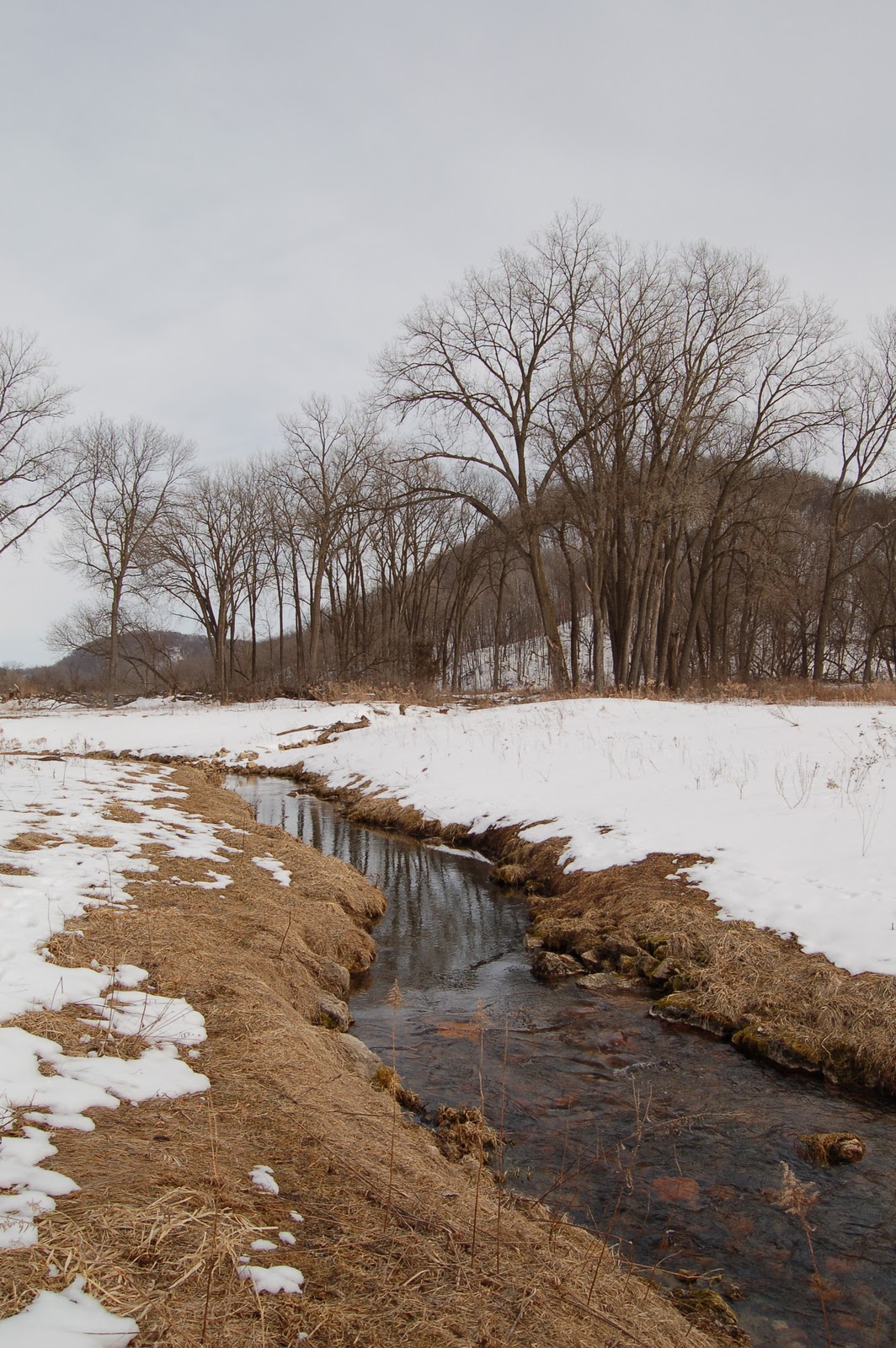
Rivers in the winter offer their own unique type of beauty.

My best winter shot so far. I love the reflection. 

Tuesday, February 1, 2011

South East Minnesota Winter 2011 Hay Creek


      I have lived in Minnesota for almost six years now and I have gone winter trout fishing almost every year.  Out here, the trout season closes in late September to allow the resident brown and native brook trout to spawn.  The season officially opens up for catch and release on January 1st.  I have always wanted to get out on the first but have never made it.  I’m either too hung over or its too cold.  Too cold is more often the reason out here in the frozen tundra of Minnesota.  It not only gets cold but it stays cold.  So cold for so long that the ice on lakes and even the St. Croix river gets so think you can drive your truck out on the ice.  You could, but I don’t. In fact I have never been ice fishing.  There is something funny to me about driving a truck out on the ice and then drilling a bunch of holes around it.  The trout streams in SE Minnesota are typically spring creeks.  This means the water that flows in them likely came out of the side of a rock somewhere, or rather came out of a spring.  The water flows though limestone bluff country and eventually out into a creek somewhere.  This keeps the spring creeks cool in the summer and warmer in the winter since the water coming out of the spring is a constant temperature year-around.  What this means is the spring creeks in bluff country don’t freeze over as easy as a lake or a non-spring fed streams.  They do freeze over though, and it sucks to drive all the way out there to find a frozen over stream but that’s the way it is in Minnesota, cold.  Very,
cold.


     To avoid the frozen over experience look for a stretch of days with the air temperature around 30 degrees.  This January has been really cold but I finally got out this Saturday.  Wednesday-Friday was pretty warm; I think one day even busted 32.  I headed down to Hay Creek outside Red Wing and found that the whole steam was pretty much ice-free.  Who knows if it was frozen over and thawed or clear the whole time.  In any case, I was pretty happy to see open water.  I fished the pasture section where the TU chapters had come in a made some really nice stream improvements.  I didn’t see another car parked at any of the spots which is usually the case in the winter.  When I go out I dress really warm, too warm for the weather, actually.  This helps keep may hands and feet warm since my core is a little overheated.  I can’t manage line or cast with gloves on so keeping hands warm is pretty hard and impossible if your core is cold.  I don’t like to go out unless it is at least 20 but I have fished in 10 and that was okay I guess, not ideal.  40 is about perfect, out here that happens in March at least once and those days are absolutely the best ever. 


     Casting in freezing temps is pretty tough too.  The water that is pulled up from the stream freezes to your guides and eventually stops line from being able to pass though.  Try to cast shorter than normal to reduce the amount of striped line, you can get a few more casts that way before you have to de-ice.  I heard spraying rain-ex deicer on your guides helps but I haven’t tried that.  I’m worried about it ruining my rod finish or messing with my sharkskin.   For now, I can deal with the ice without solvents.  A shorter rod is handy too, the most iced up guide is the tip and a shorter reach to the top is handy.  I use an 8’ 3 wt.  Also, try to keep the line moving while stripping it in.  If you stop it will freeze in place and will keep you from being able to pull in line if you get hit and are fighting a fish. Czech nymphing is a good way to go in the winter.  No iced up guides that way. 
Fish are usually pretty sluggish in the winter and you need to get the fly to them, they will not chase flies in the winter.  They are usually hugging the bottom in a slightly deeper and slightly slower section of the stream than they are in summer.  Fish usually pod up in the winter so where there is one there should be more.  If you spot a pod and drag a few flies right trough them with no luck, those fish are likely not feeding and in a holding lie.  Try to find a little faster water than that or maybe a little bit more broken up to find feeding fish. 


    In the winter nymphs are the way to go.  In fact, nymphs are usually the way to go no mater what season but since there are lots of insects on there surface in the summer and it is more fun to catch trout with dry flies that type of fishing gets a lot of attention.  I bet quite a few people disagree with that but trout eat most of their diet subsurface.  That’s just the way it is.  Two nymph rigs are a great way to go in winter.  I like to use a 7.5’ 5x leader with a bead-head fly (18-16) tied to that and about 10-12 inches of 5 or 6x tippet tied to the bend of the bead-head hook.  I tie a midge nymph (#18) as the trailer fly.  Remember to open your loops when casting a two nymph rig.  Casting gets tricky with an indicator and the two flies.  Opening loops means slow down and lengthen your acceleration during the forward and back cast.  The faster and shorter the acceleration the tighter the loop, do the opposite.  Slower and a little longer will open up your cast and cost distance but it should keep you from tangling up as much.  Also, be sure to keep the length of tippet between the flies pretty short.  Two feet is impossible for me, if you are have a lot of tangles try shortening that tippet length. You can go as short as 8 inches in my opinion.  
    I headed out to the water with my 3 wt, waders with long underwear, two base layers, my 700 fill down jacket and the warmest hat with ear covers I own.  It turned out I could have not worn waders and been fine but I wasn’t sure if I was going to have to cross anywhere so I wore them anyway.  It was actually a pretty nice day out for January in Minnesota.  The temperature was about 24 degrees and there was just a touch of wind every now and then.  I first tied on a size 18 gold bead head pheasant tail and put on a small thingamabobber (by far the best indicator I have used, adjustable, durable and visible. What more do you want?). I tried that in two pools that looked dynamite and didn’t get a touch.  Takes are pretty subtle in the winter but I set the hook on a few stalls of my indicator and got nothing.  I switched to an orange scud (#16) in the next pool down and got a few bites right away.  One hook up, but I lost him.  I lost the scud in some dead brush across the stream and decided to go to a midge nymph, size 18, black with a little peacock thorax.  I got a few more bites and hooked two but no luck getting any in.  The barbless size 18 hooks were being pretty though on me.  I should have had three fish at least, but I went home skunked.  I could have gone to two nymphs but with all the ice I was having enough trouble casting.  If I was Czech nymphing I would have tied another one on for sure.  I felt okay being skunked after I talked to an older guy with about 17 tippet spools on his lanyard and a sieve on his belt who was also skunked.  My logic here is if you know what to do  with all that gear you are better than me.  Plus, he was telling me about every hole in the stream, its name, average fish size etc.  We both agreed to was tough out there that day. I passed him on my way back and he said got one that went 12”.  Good for him, I couldn’t shake my skunk.  It was good to get the line wet (and frozen) and get a few tugs.  Maybe in a few weeks I’ll give it another go.  It sure was good to get outside and listen to a stream for a few hours.