Thursday, September 9, 2010

Big brown on a Morrish Mouse


    I was camping at Beaver Creek Valley State Park over the weekend.  I love this park for many reasons including the great fishing. The creek is crystal clear and very cold. The creek in the park literally comes out of the side of a bluff. The aptly named "big spring" makes up about 90% of the water flow and if you are standing in the water anywhere near that spring your feet will likely be numb.  I don't carry a stream thermometer but the water is at least as cold as the Sierra Nevada snow melt streams of my youth.  I started out fishing only one spot the day we got there and got one on a parachute adams but that was it.
From a trip a few years back
Nice fish from a year ago
Caught 5 minutes after the above fish in the same spot
This is the spot I fished the mouse in.  I stood on the bank at the top of the pool on the left.
I caught this nice sized fish a few years back in my favorite spot.
Same as above fish.
The fight with my 3wt with the above fish.  What a battle!

    The next day I checked out some fishing on Beaver Creek outside of the park.  I found a stretch of easement and walked up stream.  I walked right up to a spot that was a lot better than I thought. About 50 fish scattered so I had to come back to that spot.  I fished up stream and got one bit but no fish before heading back to the good spot where I got a nice 14 incher off a bead head prince.  The rocks in the stream were covered with case building caddis.  I pinched a few out of the case and they were bright green.  I didn't really have anything to mimic that so I went with the prince thinking the peacock body was better than nothing.  I made a mental note to tie some caddis larva with green bodies.  I went on to another spot that was wider, warmer, and off color.  I was hopping for a big brown.  I fished a few spots with no luck but while retrieving my nymph something big chased it towards me.  I stopped and let it settle and he turned back to deeper water.  I'm pretty sure that was a big 20" plus brown.  He chased a gray scud and I thought he might want a bugger or some sort of streamer action.  No luck.  I tied on a pink squirrel and while retrieving it after a drift I heard a huge splash. I set the hook and came up empty.  This fish was tormenting me.  I finally tied on a Morish mouse and pulled it across the top of his spot a few times with no luck. 

    What really sucked about that is somewhere in that nettle infested river bank I lost my camera out of my shirt pocket.  I went back to look twice and couldn't find it. 
    Later that day after dinner I went back to one of my favorite spots that is right near the parking area for the park.  I caught one on a dry and with the last rays of light I tied on a nymph.  No luck.  I had been thinking about my Morrish mouse pattern but it was too dark to tie anything on. I decided I needed to at least try my mouse pattern once before the season ended so I walked back to the car and tied it on with the help of the trunk light. 
A little guy with par marks still.  Likely a yearling. 
Yeah, that's the water. Crystal clear. 
Beautiful beaver creek.

    I walked back down to the river and stood at the head of the pool and tried to cast my 3 inch long mouse pattern more than 10 feet.  My first cast was the best, I got it out about 20 feet and started to slowly strip it back in.  I felt a sharp tug, tug and I set the hook, with nothing on the other end.  Was that a fish?  Yeah, that had to have been a fish.  I tossed it out again the fly made a whoosh whoosh sound as it flew over my head.  A 6 wt would have been nice with such a bushy fly.  This time I plopped it down about 10 feet from the bank and just bobbed it in the current with the line pinched in my rod hand.  All of a sudden, in total darkness I heard a huge splash!  I waited just a half second, which is all I could manage with all that excitement and set the hook. Bam! Fish on!   He took off to the other side of the pool taking about 15 feet of line out. Luckily, my leader had been chewed back about 3 feet so I had about 4x instead of 6x where I tied the fly on.  I doubt fish are leader shy in total darkness.  I got the big guy in pretty quick and had a tough time with the net since I could only really hear the fish and could barely see what I was netting.  A head lamp would have been nice.   The fish looked female and was a thin 17 inches maybe.  It was pretty dark and the few pictures I took were pretty bad since I couldn't see through the view finder.  I thought since big browns ate mice in Alaska why not in Minnesota? Now I know for sure.  I had two casts and had two bites.  I only tried that one spot but I will surely try it again in more places, hopefully better prepared than the first time. 
Got him!
Mouse for dinner?
Wow, it was dark. 

Tuesday, August 31, 2010

Fall on the North Shore

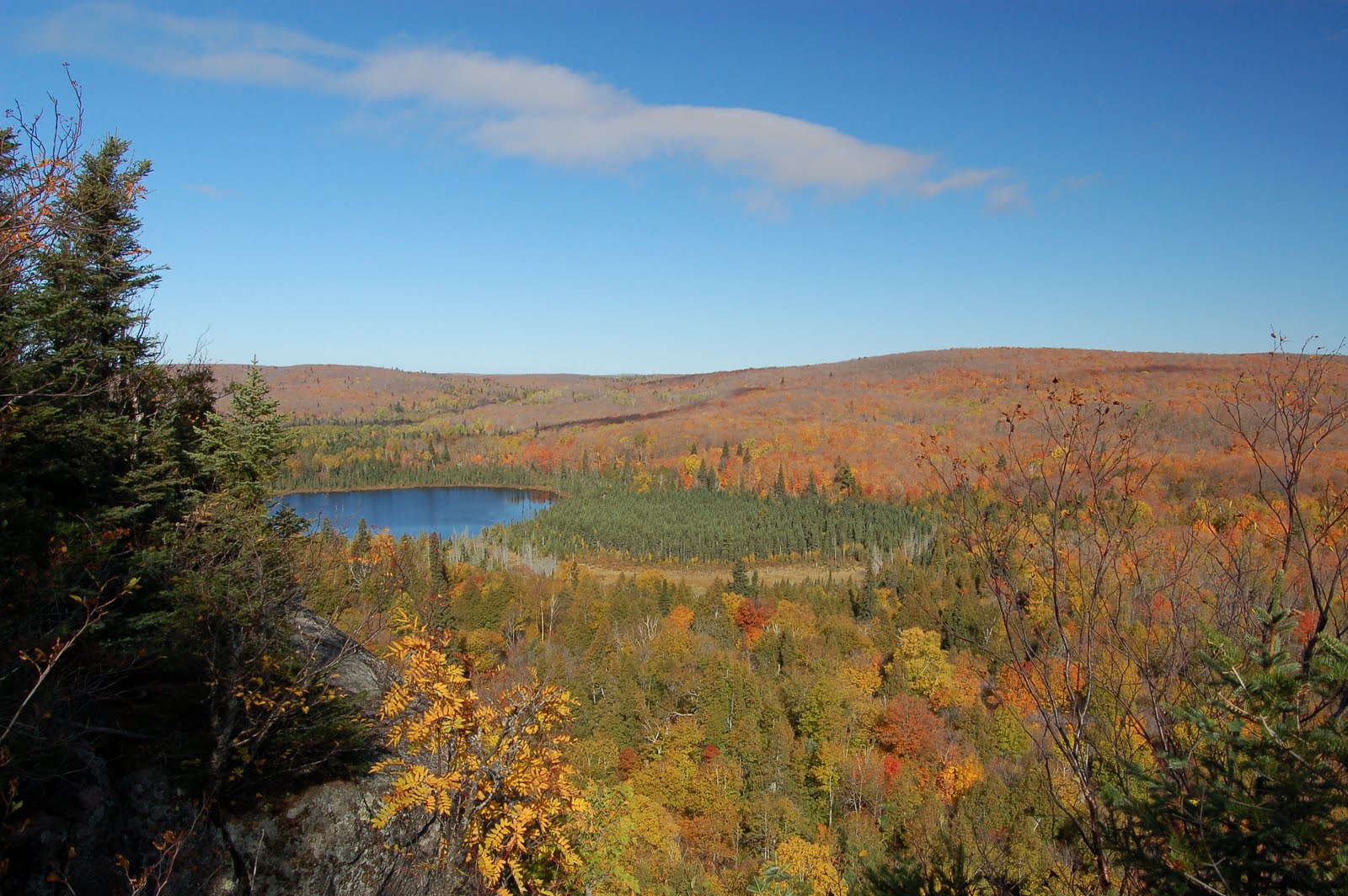
     Although it is supposed to be nearly 90 degrees today and humid as a sauna, fall is on my mind.  The Sate Fair is here and cooler nights are in the forecast.  Soon the leaves will change colors and there are few better places to witness a sea of fall colors than the North Shore of Minnesota's Lake Superior.  The combination of rocky rivers and blaze orange maples always tempts me into a picture or 500.   There are a number of places to stay on the North Shore.  My favorite is Easy Bay Suites in Grand Marais.  The staff is friendly and rooms are freshly renovated.  Plus, the view is amazing.  The place sits right on the water.   Grand Marais is a great town too.  There are at least three restaurants that are great and one in every price range from the Crooked Spoon on the high end to My Sisters Place on the dive/but great food and beer end.  The Gunflint Tavern sits as a nice middle ground with a great beer selection and a fresh modern menu. 
Cascade River
Cascade River
Beautiful North Shore veiw
Cascade River State Park
Oberg Mountain

    I would not recommend the Beaver Bay Inn in Beaver Bay.  Unless you want unwashed sheets and/or to stay in a renovated trailer.   I would stay away unless it is the last place on the North Shore.  Unfortunately, it happened to be the only place available for us one year. 
    The other great attraction to the north shore in fall is the pink salmon run.  Even if you are not a fisherman/fisherperson the site of migrating salmon up a river right in front of your eyes offers a real connection to a species' fight for survival.  No one apparently knows how the pink salmon were introduced to the North Shore but it appears they are here to stay.  All pink salmon are naturally produced; the DNR does not stock these fish.  The salmon come into the rivers along Lake Superior in mid September and spawn through early October.  They lay their eggs in the gravely river bottom where they develop until March or April.  Then they leave the river and live in the lake for usually 2 years before they return to spawn.  Spawning is a one time event for salmon.  The males drastically change their appearance.  They grow a mean looking hook jaw and form a huge humped back giving the pink salmon their nick name, humpies.   The females generally look as they do in the lake.   Once they enter the river their stomachs collapse to make room for eggs and their bodies start to decay.  Since pink salmon do not eat while spawning in the rivers, it is best to target fish that have just entered the river and attempt to illicit an instinct strike.  This can be done by drifting either a large fly that imitates something that may be a risk to the eggs like a minnow or, as a different tactic, an egg pattern that is literally drifted inches from the fishes mouth. 
    Pink salmon are not known for being great eating fish.  When caught in the lake the flesh is firmer and better but once they enter the river they start to get a little mushy. The best bet for good eating fish is to release fish that look a little decayed and keep ones that look fresh from the lake. 
    On another note, there may be people present who are snagging or otherwise illegally "catching" fish.  This is poaching and should be reported to the DNR.  A few years back I saw a person reeling a 3/0 treble hook through a group of over a hundred salmon.  He dragged them in by their backs and tossed them in a trash bag on shore, alive.  It is possible that you will snag a fish by accident since there are so many fish but try to bring it in quickly and release it immediately.   Taking a few legally caught fish home is perfectly okay. There are so many fish in such a small spawning ground I think all possible sites for fish to develop are saturated.
Pink salmon spawning.  Notice the big one in the middle?  Yeah, that's a King salmon.  There are a few of those around but not many.
Call to report poachers:
1-800-652-9093
http://www.dnr.state.mn.us/enforcement/tip.html

    The sheer number of salmon in the rivers is amazing.  Hundreds of fish school together and spawn in the pools of north shore streams.  The two places I have seen huge numbers of fish and have actually caught fish were at Cascade State Park and Temperance State Park.  At Cascade, walk up river from the highway 61 crossing to the first slow spot in the river.  There should be fish stacked up along this run for about 50 yards.  At Temperance, walk towards the lake and to a small beach on the south side of the river. There should be fish right at the river outlet to the lake. 
Temperance River State Park
    Even without fishing the North Shore is a beautiful place to visit that time of year.  I hope you will enjoy it as much as I have over the last few years.

Tuesday, August 17, 2010

I was recently back in San Diego for a conference and to visit my family for a few days. The last time I was there over the winter I gave some surf fishing a try. I didn't catch anything but during the winter there are not too many fish in the surf. Summer on the other hand is sand crab spawning time and the beaches are alive with all sorts of fish and little crabs diving under the sand in the breakers.
This time, I decided to get some flies at a local shop and figure out what equipment I should be using. Basically, I found out that I didn't have any of the right equipment with me. I left my 9 wt at home due to lack of carry on capacity and I figured I could borrow my Dad's 5wt. The 9wt would have been okay, maybe a little heavy. My intermediate line would work okay as a running line but I really needed a shooting head. And a striping basket, for sure. I know, a striping basket for surf/beach fishing sounds funny but, as I found out later, they are absolutely required. I read on a forum somewhere that a pretty nice striping basket could be made from a small dish tub and a nylon cinching belt. In fact, a very nice striping basket can be made form the a fore mentioned parts and everything, including a waterproof box for my camera, can be found at walmart for less than $15 (the striping basket parts totaled $4 the waterproof box was $11). So, with a under-weighted rod, no shooting head, and some pretty bulky heavy flies, I tried surf fishing.
Torry Pines State Beach
I was standing about where this is about to crash.  Not as much fun with a striping basket and a rod as it is while swimming
Surf fishing with a trout rod.  Don't try this at home. Notice the size of the fly I was trying to cast.  It's almost as long as my reel. 

Can you tell I really set myself up behind the eight ball? Yeah, here we go. My first tip is make sure the striping basket is in the right spot. There is nothing worse than striping in a bunch of line directly into the tumbling surf. If you think a current does bad stuff with striped in line you should see what the surf can do. Second tip: pick a beach that has some time between breakers. I tried Torry Pines State beach first and really had a tough time. I waded in about up to my waist which is right about where the shore break was crashing. The waves were about 1.2 seconds apart which gave me about 10 feet to cast before the next wave would crash and send my line every which way. The idea is to wait for a wave to break in front of you and cast between waves. Since there was no time between waves, there was no place to fish. I left defeated and pretty wet. I was fishing in my trunks with my shirt on and I was soaked. I got back to the car and realized I forgot a towel too. Now I was wet, fishes and very frustrated.
This sport did not exist in San Diego when I moved away. 

I headed back up north to try and find a beach with more spaced out waves. Once I go up to Carlsbad I found a nice stretch of beach that was flatter and seemed to be just what I was looking for. I waded out and realized what my next problem was going to be. It turns out, that I can cast a surf fly with a 5wt about 40 feet which is about 40 feet too short. I had huge open stretches of water to cast to but I could only get my fly out maybe 50 feet if I really tried hard. I see why a 7wt with a nice shooting head is standard equipment. Once again I couldn't shake the skunk and I went back in.
Carlsbad State beach
I learned a few things. Having the right tool for the job is just as important in fly fishing as all other endeavors. Its just too bad my wife doesn't understand why I need ANOTHER fly rod and another fly line and oh yeah, another reel that won't get destroyed in salt water. Maybe if I move back to San Diego I'll get the right stuff but for now, maybe next time I'm in town I'll try out the sweet water river with my 3 wt for some trout.

Friday, August 13, 2010


I was up in north central Minnesota over the 4th of July and again a few weeks back.  There are not too many trout streams up there but I tried my luck in both of them.  The Straight river flows near Park Rapids MN and is one of the premier trout streams in the state.  Apparently, not were I was fishing.  It was choked with vegetation on both sides, which made walking the river almost impossible.  I think I saw 1 trout but there were too many chubs hitting my fly to have a fair chance at the trout.  There has to be better spots somewhere on the stream but I would skip the spots near Osage and try down near Highway 71.  What the Straight lacked in fish quantity it made up for in absolute stunning scenery. I'll add some pictures soon. 

I also fished Stoney Brook that flows into Upper Gull Lake near Nisswa MN.  This stream is spring fed and ice cold even in late July. Stoney Brook is catch and release for all brook trout and has quite a decent population because of that.  The main difficulty is finding a spot were a cast doesn’t spook all the trout in the pool. It runs slow and gin clear close to the parking area. Try heading up stream and fish moving and broken water for better luck. I ended up catching 4 in a few hours.
A respectable sized native brook trout
He decided to hang out by my feet for a second
One of the only runs that was fishable

Thursday, July 29, 2010


The south fork of the Kings River flows though Kings Canyon National Park and is probably one of the most scenic and best trout fishing rivers that happens to be in a National Park.  There are many family oriented activities in the park like hiking and guided nature tours to keep the whole family busy but the real draw is the hard fighting wild rainbows and browns.  Inside the park fish average 10 inches but sheer numbers make up for size.  There are so many that 12-13 fish can be caught every day.  South of the park the river enters a carved steep canyon and exits the glacier-widened canyon inside the park.  This part of the river has bigger fish in the 15-25” range and is protected as a wild trout stream (access at Yucca point trailhead).  
            I have been fishing the South Fork of the Kings River ever since I could hold a rod.  I went back this year after not being able to go for a number of years.  Unfortunately, I had to go in July and even worse there was a record snow pack in the Sierras.  All that added up to a river that was barely fishable.  As soon as my fly hit the water I felt like I was in a NASCAR race.  Vroom, my fly takes off down stream and is past me in a second.  I can barely see it go by; what chance do the fish have?  Not much, actually.  I didn’t catch many but I found a few slow pockets and could sight cast dries to rising fish. The one picture of a fish I did get on the trip is of a pretty small fish but the colors and spotting are amazing.  Obviously, this was not a hatchery rainbow. 
This tree ruined what was a great fishing spot.  I guess it is not ruined for the trout, just for me. 
Beautiful par marks and white tipped fins!
This snag monster and the under water tree in this spot has at least $20 of my Dad's and my flies stuck in it. 
            It is still a beautiful place and the water is even colder than I remember.  Once again, I have a really good reason to go back. 

Tuesday, July 27, 2010

The Little Kern Golden Trout

Pointing at Farewell Gap 6.5 miles away.
Looking back at Mineral King

The Little Kern Golden Trout (O. mykiss whitei) is the second prettiest fish in the world. Except for the stunning South Fork Kern Golden trout (O. mykiss aquabonita) the Little Kern Golden has the most spectacular coloration and features a trout can have.  Unfortunately, the Little Kern Golden is not as well known or photographed as the South Fork Kern Golden, which holds the honor of being the California state fish.  Tucked away in a high Sierra valley only accessible by a long, up hill, multiday backpacking trip, this beautiful trout has only been seen or caught by dedicated outdoors people.  Whether the trout’s stunning colors were a surprise for a passing visitor or a celebrated triumph for a trout enthusiast no one could deny that the Little Kern Golden is a unique and beautiful fish. 
The Little Kern River and Farewell Gap

            The Little Kern Golden is most closely related to the South fork Kern Golden trout, which is the ancestral species of the Kern valley and also known as either the Volcano Creek Golden Trout (geographically separated from the South Fork Kern Golden by a waterfall in Volcano Creek) or the Golden Trout Creek Golden Trout (the south fork of the Kern is also called Golden Trout Creek).  The South fork Kern Golden took residence in the Kern valley approximately 70,000 years ago (Benhke 2002).  At some point the Little Kern Golden became geographically isolated and evolved slightly different characteristics during thousands of years of isolation.   The Kern River Rainbow Trout was also isolated from the same ancestral population and has diverged more dramatically to resemble a coastal rainbow.  It is thought that coastal rainbows may have inter-bred with the Kern River Rainbow though invasion form the San Joaquin river system.  
            Both the South fork Kern and Little Kern have olive to golden-olive backs and golden flanks with a crimson red lateral line.  They have white bellies and iridescent purple par marks throughout adulthood.  The South fork Kern Goldens have large spots concentrated at the tail that fade towards the head.  Little Kern Goldens have significantly more spots and variation in spot size.  Spots occur from head to tail and predominantly above the lateral line. 
            I spent at least one week in the Sierras every summer I lived in California.  I mainly camped and fished in Kings Canyon National Park but have backpacked in the Golden Trout Wilderness as well.  My first trip for Goldens was to the Cottonwood Lakes area in the southeastern Sierras.  The Cottonwood Lakes were used as fish-rearing facilities for South Fork Kern Goldens and although they are not used for that purpose anymore they remain a decent spot to catch some beautiful trout.  Since they are not part of the native range of the South Fork Kern Golden they do not count for the California Heritage trout challenge but they are a great place to visit.  You have to be able hike 6 miles starting at about 10,500’ and finishing well over 11,000.  You also have to sleep at very high altitude, which can be hard on the brain blood vessels.   Two weeks ago I headed out of Mineral King in southern Sequoia National park to the head waters of the Little Kern River to try and catch a Little Kern Golden trout.
            We had spoken with a ranger the previous week and found out that the pass we were planning on heading over, Farewell Gap, was still very snow covered and no one had made it over yet.  We gave it a shot anyway and set our sights on getting over to the Little Kern valley.  The hike was about 8.5 miles and 3000 feet of elevation gain culminating at the 10,500 foot Farewell Gap where Sequoia Park ended and the Golden Trout Wilderness began.  It took 7 hours, 3 dangerous river crossings, 3 perilous snow reroutes, 1 hail storm and 1 nearly lost hiking boot to get there but we made it.  We were the first people of the year to make it over and were completely alone in the Little Kern valley.  Ahh, solitude. 
Top of Farewell Gap
            The valley was amazing.  Bristle cone pines dotted the rocky mountainsides and the Little Kern River cut a silvery slash across the verdant valley floor.  The river was moving really fast, fed by snowmelt creeks that seemed to spring from every crevasse in the valley walls.   Water falls cascaded off sheer cliffs in nearly every feeder creek.  The Little Kern River originates from upper and lower Bull Frog lakes and drops 1,100 feet in 0.5 miles on its way to the valley floor.  A spectacular waterfall coming down from the lakes seemed to be an impenetrable fish barrier.  
Fishing the Little Kern

            The next day we hiked up to Bullfrog lakes.  A few websites say that upper and lower Bullfrog lakes have Little Kern Goldens so I thought that would be my best shot for catching one since the river was swollen and running too fast for fishing.  The lower lake is at 10,700’ and we started at about 9,900’ so it was tough going and the trail wasn’t exactly easy to follow.  We got up there and ran into a mother and her two daughters.  They had hiked through the same hail we did and made it up to Bullfrog the night before.  They traversed without a trail from the pass to the lakes.  I can’t believe they made it.  What a tough day.  We hiked over to the lake and didn’t see any fish.  In fact, both lakes as far as I could tell were fishless.  Upper Bullfrog was still partially frozen over so who knows if the trout were active yet.  I assume that if there were fish at all they would try to start feeding as soon as the ice was off the surface.  Maybe they were still deep and not active yet but I doubt it.  I think they are either fishless or nearly fishless.  I walked back down, defeated.  I tried the river all day in every possible pocket and pool with dries and nymphs, big and small but no fish.  I didn’t even see a fish skitter away at any point.  The upper Little Kern headwaters do not contain a sizable population of trout, at least in July after the melt.  I’ll have to try again and come in from the South where the river is larger.  
Lower Bullfrog Lake
Upper Bullfrog Lake
High sticking with no success

            Even though my trip to catch a Little Kern Golden was unsuccessful it was still a great backpacking trip and the scenery was spectacular.  Honestly, any trip to the Sierras is a success if you love the outdoors.   
Looking out towards the south at sunset.  The Little Kern Golden is somewhere down stream....