Tuesday, June 29, 2010

Trout in Las Vegas

As I got on the plane to Las Vegas with my fly rod I got a couple of strange looks. Maybe he’s connecting to Salt Lake? Yeah, that’s it. But no, I was headed for Las Vegas and thanks to a chance stumble upon a blog post I had found a stream that had one of the most beautiful and rare trout species in the world. Lahontan cutthroat trout (Oncorhynchus clarki henshawi) evolved in a prehistoric lake (lake Lahontan) that covered a good portion of California and Nevada. Lahontans are the largest species of Cutthroat trout and originally inhabited smaller remnant lakes of Lake Lahontan such as Pyramid, and Walker Lake. Due to a number of man induced catastrophes the largest cutthroat trout species know to man became extinct in pyramid lake. Populations have been re-stocked from lake tributaries and Spring Lake but do not attain the same size as the original Pyramid Lake strain.
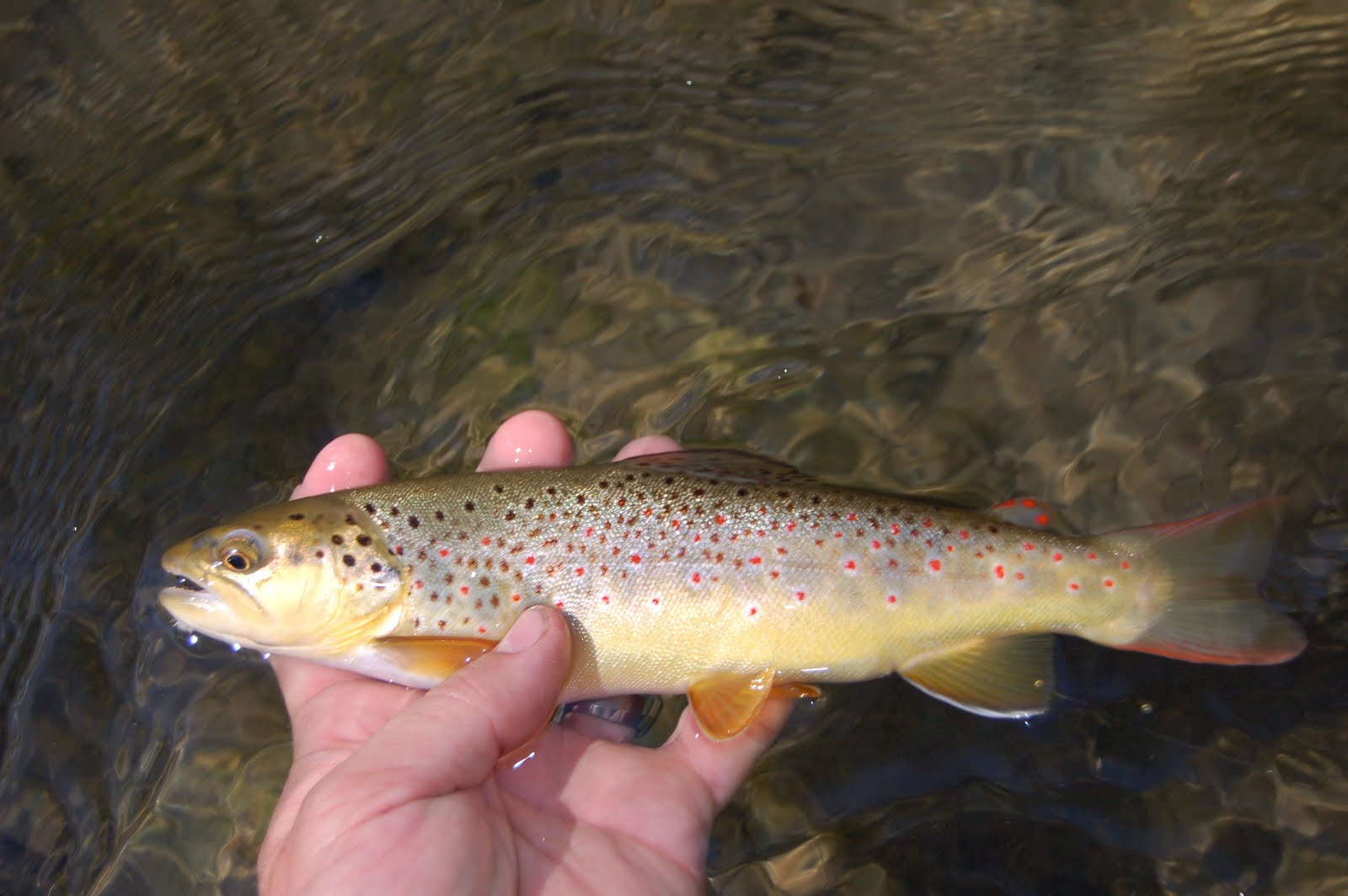
The LCT has a golden hue, a red lateral line and is spotted along the dorsal and lateral body. More spots occur near the tail tapering off in number toward the head. Par marks can be present along the lateral side as well. And like all cutthroat trout, the Lahontan has slashes or orange or red along the lower jaw.
Fortunately, I convinced an old friend to drive out to Vegas instead of flying so we would have wheels on Saturday for our adventure. I had read the road was pretty rough and a high ground clearance would be required. Well, does a Chevy Impala count? Not really, but we made it far enough out to have a short 1 mile walk to the stream. It was about 14 miles from the blacktop to the stream and it took us 90 minutes to get 13 miles. Vegas was 106 degrees but it was barley 70 at 7500’ where we met the stream. Cactus and Joshua trees had faded to pines, the landscape transition was extraordinary. I felt like we had been transported to the Sierras. Who knew this was so close to Vegas? Well, about 50 other people that day apparently. Luckily, none were fishing but all were laughing at the Impala driving out-of-towners.
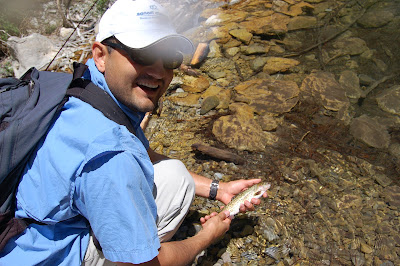
We found a spot where we could see a few fish. The water was cold and gin clear. Beer cans and trash were tucked here and there, way too much for one person to carry out. Its too bad there was so much trash is such a beautiful place.  A few casts just spooked these fish, we moved on. After trying a few small spots we came upon a nice deeper hole maybe 4 feet deep. I tried a few casts and got one to rise on a Wulff. The first fish was nice sized and dramatically colored. My first Lahontan was definitely a fish to remember. A few quick pictures then I lowered the fish down and he exuberantly swam off. We tried to bush whack back a ways but found no other pools. We came back to the same spot and got three more off nymphs. In hindsight we should have tried more terrestrials. We saw a grasshopper that must have been 3 inches long on the way in. Next time. In spite of the fact I was hung over and could barley hold my hand still from all the coffee it took me to get awake we made it out and back to the stream with no serious damage to us at least. The Impala is another story.


As far as my quest to catch all of the native trout in North America goes I have two cutthroat down and hope to cross off the little kern golden in two weeks.

Here is my list so far:
Volcano Creek golden trout
Kern river rainbow
Minnesota and Wisconsin brook trout
Minnesota Lake trout
West slope cutthroat trout
Lahontan Cutthroat trout

I have a ways to go yet.

Monday, May 17, 2010

Smaller is better


Like many things, successful fly fishing takes confidence. Confidence in your cast, the tippet size and especially the fly. I have my favorites and rarely stray too far from a pink squirrel or a bead head prince nymph. I like thick dubbed flies and sizes 12-16. Maybe an 18 if nothing is biting. I fished for 3 hours on Saturday and caught one fish on a prince nymph. Everyone seemed to be real chatty on the river and very nice, which was good because it was crowded. Someone was fishing in almost every spot. I was walking back to the car when I saw a guy pull in a nice trout fishing a nymph rig with an indicator. Just what I was using but with no luck. He was an older guy with a TU hat and enough tippet spools hanging from his lanyard to let me know he was serious. He waved and I walk towards him. He asked if I saw any surface action and I said I hadn’t. I asked what size nymph he caught his fish on and he walked towards me and wanted to show me. He actually walked half way across the river and showed me his setup. To say the flies he was using were small is an understatement. They were tiny, nearly microscopic. The body of the flies was no more than thread or a little pheasant tail wrap. Super sparse and a tiny thorax to match. He pulled out his fly box and gave me two flies, one with a reddish body and one black one. I felt like I had just met my fly fishing guardian angel. He was a really nice guy and told me to go upstream and kick his buddy out of the good spot he was hogging. I didn’t kick him out when I walked by, instead I went up to my favorite spot that happened to be empty. I tied on both of the flies he gave me in a two-nymph rig with a tiny split shot just like the old guy had. The first cast I hooked a little trout and got him in. The next cast I hooked a bigger one but broke him off. Two casts two fish on the little red looking pheasant tail nymph. This is after not catching a damn thing for hours. Not even a bite and I get two in two casts with this little fly I would never have thought to use. I tied on the smallest pheasant tail I had, which looked huge compared to the one I had just lost. A few more casts and I had another one. This time on the other fly he gave me, not the one I tied on. A few more casts and I hooked a big one. He took me up and down the pool three or four times but I finally got him in. He was about 15 inches and had some serious girth. He was developing a nice hooked jaw like the huge browns have and had a brilliant yellow color. I guess I should get to work tying some tiny flies. I ended up losing both that he gave me but you can see the black one in the corner of the big trout’s mouth so I should be able to replicate it. I guess I should always bring extra so I can pass on the knowledge to someone else. I wonder how many fish I would have caught if I had those flies all day...


Tuesday, April 20, 2010

Grey/black Caddis time!


Wow, what a day Sunday was. A huge grey caddis hatch started about noon and was in full swing by 2-3. I can't remember ever having so many huge strikes on dry flys. When trout hit a caddis they don't seem to miss or mess around. I only missed 2 strikes all day. One because of slack line......The two most important things beginners screw up constantly that keeps them from catching fish is imprecise casting and line management. Not only do you have to put the fly where it needs to be without spooking fish, you need to manage the line through the drift so if you do get a strike it will result in a hook up and not just a lot of line pulled off the water. I mess those things up all the time and I am going to try and give myself and everyone else some advice. Be methodical when you come up to a spot. Stay back until you know where you want to set up, when you get setup take your time and make the first cast the best. I put down so many fish this weekend because I was so exited about making any cast I made the wrong one, from the wrong spot and spooked the whole pool. I did catch fish but I should have caught twice as many.

Tuesday, March 23, 2010

Clear water during the melt


The weather two weekends ago was pretty amazing. It was about 60 degrees and there wasn’t much snow in sight. I wanted to get out and fish but I was afraid the water would be really off color and super high. I decided to head out to my favorite brook trout stream that I thought would clear the fastest of any nearby. I was right, the water was clear but not as clear as it has been. I have seen it so clear you might re-think what a clear gin might look like. I could still make out the blue spots on the side of brooks in the calm pools. Stealth is key on this stream but since there are fish pretty much everywhere it is almost impossible to walk up to the stream and not spook something. The best bet it to find the plunge pools or faster riffles and start as far back as you can. I thought nymphing would be my best bet so I didn’t even bring my custom 6’6” Lamiglass small stream rod. Besides, there were intermittent wind gusts that would really test my patience later. I had a 3wt loaded with my new Shark Skin line and a 6x 9' leader. I tied on 18” of 6x tippet and thought I would give a Royal Wulff a try. My first cast landed about 2 feet from the really rough water in a plunge pool and instantly the water erupted around it. Wow, it must have been a long winter for these little guys. I pulled in a nice 7 incher.


It was a little tricky getting used to the new line. All this shooting slickness and floating was a little strange after fishing with my 3 year old Mastery SA line with the first 3’ converted to and intermediate sink tip due to excessive use.
I fished a few more spots up stream and circled back to a spot I never really had any luck in. It looks really good but I never really hooked a lot of fish there.

I switched to a Parachute Adams #18 and got a hit right away. I ended up landing about 10 fish from that spot and a few nice sized 10” fish.


There was no consistent hatch but I did see quite a few fish feed on the surface over the course of the day. There were midges and something else bigger I didn’t get a look at but was likely a Baetis (Blue Winged Olive). Maybe even a size 16. Pretty big for March but it was 60 degrees outside which is pretty unlike March. Funny thing was, I never even had to switch to something specific on top to get strikes. I love brook trout. You know it’s a good day when you stop setting the hook on fish you think are too small. The wind finally got the best of me and I was struggling to even hit the stream when gusts would pick up. I took down my rod and headed up stream to a section I haven’t fished to scout it out for next time. There were a few cars parked and maybe three guys fishing up there. I hadn’t seen anyone besides hikers all day. I kept my distance and watched for a minute. The first guy I saw was launching perfect loops and seemed to be in compete control. I hope that is what I look like out there but doubt it. They guys walked back my way and one of them looked a lot like Andy from the graygoat.com. It was him, we talked for a minute. What a nice guy. I thanked him for updating conditions and providing such great info about Minnesota and Wisconsin fly fishing. Cheers Andy!


Tuesday, March 16, 2010

WS season opener


I fished the Wisconsin trout opener two Saturdays ago. I went to, probably, the most crowded worst place to go for the opener, the lower Kinny. I couldn’t get out until about 1 in the afternoon and when I got to the lot at the park there were a group of guys getting ready to head out. There were three of them and I asked if they had any luck earlier (they were wearing waders when they got out of the truck). The bigger guy in the very nice Sims waders said they did okay over on the Rush in the morning. All three guys had fly rods, one had a nice lab tagging along. At this point I reailzed it was going to be a rough day. I forgot my reel with 3wt line and only had my reel with 5wt. Yep, only brought the 3 wt rod. I strung it up anyway, I wasn't going to let a 2 size overweight line ruin my first day out. I realized I’m not going through leaders like I used to. I had at least 8 feet left on a nine footer from last season. I’m pretty poor and I don’t tie my own leaders (see tying leaders and throwing beer cans, a previous post) so I used it anyway. I tied on about 18 inches of 6x and a trusty pink squirrel. I stated the walk out to my favorite spot knowing that if there weren’t three guys and a dog there someone would be for sure. The walk down was interesting. The ground was still mostly snow covered and I have felt soled wading boots because that is really all they sold when I got mine. They suck in the winter. I can’t afford $150 bucks for a new pair of boots so I fall a lot in and try not to break my rod for the third time (thank god for the Winston guarantee (calm down, I only have a $200 Ascent and it has the same warranty as the big boy rods).


There was a guy in my favorite spot so I headed down farther, two more guys in spots I usually skip. Hmmm, bad sign. I kept walking and found the three guys with the dog. They were standing about waist deep in about the middle of a spot I usually cast to, not wade in. Much to my chagrin, one of them hooked up and landed a fish as I was taking a few pictures up stream.

I had to walk out quite a ways and finally found some good water. I hadn’t fished the spot I started at and was happy to find it. Crowds are good for something. It was a little fast for early season, I’ll have to come back when the water warms a little and the fish get some energy back. Browns are notorious for laying back in the calmer water in pools. I caught one on the squirrel and moved on.


I switched to a bead head prince nymph (all #16s) and fished another spot just down from the three guys who were still, amazingly after 1 and a half hours, catching fish in the same spot. Life is not always fair.

I moved back past the crowd and walked back over to my favorite spot and, thankfully, a guy was just leaving. I moved in and decided I would give the old two nymph rig another chance. I tied on a size 18 orange scud to the bend of my bead head prince. Once I did that the action really started. I caught 5 in about 45 minutes. Two small fish on the scud and 3 bigger ones on the prince.


I’m not sure it always works out that the bigger fish go after bigger flies but it happens more often than not. The two nymph rig is the way to go. I had no trouble casting it and had no tangles. As long as the taper is set up right its easy. ~7.5 feet of tapered 5x leader-BH prince nymph-18 inches of 6x-scud. Overall, it was a good day. The weather was warm for March and the fish were biting.


Friday, February 19, 2010

Making the switch


I haven’t always been a fly fisherman. I still have my spinning tackle for trout but I never use it. I don’t even know where my box full of Panther Martins and worm hooks is. The last time I used my spinning tackle I was fishing for bass and big blue gill off my float tube. I strung up my line and broke the tip of a rod I had used since high school. I used to love that rod; it didn’t even bother me that I broke it. I wanted to learn how to fly fish but it seemed so arcane and obtuse to a bait fisherman. You cast the line? The fly hardly weighs anything? How does that work? There were more questions than answers. The different types of flies were so numerous I could barely keep straight what was floating and sinking let alone a baetis imitation or a midge. I would look at forums and see that someone caught fish on a GB prince nymph. I thought it was Great Britain….I was hopeless. If you saw me try to cast, it would make you want to duck and take cover. I took out more bushes and trees than trout that first year. I would bring my spinning tackle, catch a few fish and then switch to fly fishing to see how that worked out. It never did. Once I went fishing with my friend Mark. He was just learning to fish for trout and we were using worms. I think he caught one that day but I’m not sure. I caught a few on spinning tackle and switched to my fly rod. I needed to attach the tippet to my leader and was attempting a double surgeons knot. I say attempting because I never got it to work. It always slipped out. I finally gave up and became a decidedly sour fishing partner for a while. Mark has since switched to fly fishing and told me one of his funny beginner stories. He was sitting on the bank of a river in Montana (probably after paying something like $20 for a fishing license for the day) and couldn’t remember the knot to attach the leader to tippet. He finally gave up, tied the fly to the leader and caught a trout on a hopper pattern. That would have been enough to hook me on fly fishing. I have since learned that a baetis is a may fly and to not try to attach a thick leader to a tiny tippet with a surgeons knot. I now can catch way more fish with flies than I ever did with bait. I can tie most of my own flies and have more fly rods than most people have ties. And yes, my wife doesn’t understand why I need more than one fly rod let alone two 3wts a 5, a 7 and a 9. I sort of want a 0 but that’s silly.

My advise for learning to fly fish is pretty simple
Don’t take spinning tackle with you. If you go out to fly fish focus on that.
Don’t start with dry flies. Learn to cast a nymph, indicator rig.
Start with a small number of fly patterns but many sizes. (18-12 for most flies) Size is usually more important than the difference between a flash back pheasant tail and a natural.
Get decent equipment. If you have a $200 spinning rod and a $19.95 fly rod combo what are you going to want to fish with?
Don’t go overboard on expensive equipment either. You won’t know the difference between a Z-axis and a TFO for a long time.
Learn to tie flies. There is something great about catching/fooling a fish with a fly you tied. Most nymph patterns are pretty easy and it is a fun hobby. Like arts and crafts for adults.
Just go out and try it. Screw the books that say you can’t practice casting while you are fishing. I think the best motivation for learning to cast better is having fish right in front of you. Read about casting and maybe get a lesson then go out and do it. Learning on the water from a friend is the most common way people pick up the sport. For trout fishing you rarely have to cast more than 20 feet. Even I can do that.

I hope this helps, if I knew what I just wrote when I started thing would have gone better sooner.

Tuesday, February 16, 2010

Chaos machine: The two fly nymph rig


I used to go to the science museum a lot when I was a kid. The Ruben H. Fleet science museum in San Diego had this device that simulated chaos. Chaos can be defined as: behavior so unpredictable as to appear random, owing to great sensitivity to small changes in conditions
I agree that this is a slightly esoteric definition but it really sums up my point well. Chaos is not actually random but so many variables exist the outcome appears random. The machine at the science museum had a crank with an arm about a foot long. Attached to that crank were two other freely rotating arms. One attached to the crank and the other attached to the one attached to the crank. All of them were different lengths and thicknesses. When you turned the crank the arms seemed to go every which way and all would turn at different rates. Apparently, mathematics could not predict what the motions of the arms would be even if the input force and velocity were known. I hate maths. At this point you may be wondering why I am talking about a chaos machine on a fly fishing blog. The reason is that I created my own chaos machine two Saturdays ago.

I decided I wanted to fish a two nymph rig setup. I wanted to put a small (size 18) midge nymph trailing off my bead head. So, I had a strike indicator, about 3.5 feet of tippet (6x), a #16 pink squirrel, another 1.5 feet of tippet tied to the hook bend, then a #18 midge nymph (unweighted). I though I had a great setup. I could have a midge emerger nymph flowing through the current while the bead head was bouncing along the bottom. I have cast two fly rigs a lot in the summer. Dry-dropper setups and stuff. So this setup should have been easy. Not so. I neglected to understand how a strike indicator would factor into the equation. From the tip of my fly line I had built a perfect chaos machine. At no time could I predict where the strike indicator, the bead head, or the emerger would land. If they landed at all- I caught my share of brush behind me too. The emerger would dive for the deck during every back-cast and constantly snag. If I accelerated the cast prior to a rapid stop to shoot some line all hell would break loose. After a few casts of fearing for my life, hooks flying everywhere, I took off the nymph and order was restored. I know it is possible and even fairly easy to cast that rig if it is setup right but I failed, miserably. I should have tapered my leaders down. I needed a 5x 7.5’ tapered leader, the strike indicator, 6x tippet, the bead head, 7x tippet, then the nymph.  5x, 5x then 6x would be fine too.    It would have turned over much nicer.   The real key is to open your loops and relax your casting stroke.  Shoot tight loops with dries and open them up for nymphs with indicators and especially with two fly rigs.

  I’ll let you know how that works out next time. My money is on a slightly reduced chaos machine and a few more tangles than usual. It was the first time since September I had cast a fly rod; maybe I was just rusty.
I did manage to catch two. They were pretty small but I wasn’t fishing the best water on the stream. I’ll try down by the pasture stretch next time.